

facebook
Skip to Content

Today, nearly 20% of Americans live in rural counties.1

Compared with their urban counterparts, people living in rural communities tend be older and are at higher risk for poor health outcomes, underscoring the importance of access to care for these populations

At the same time, these communities face significant barriers to accessing care, and 80% of rural America is considered medically underserved.

Humana has long prioritized strengthening access to care for people living in medically underserved areas as part of our mission to advance health equity by reducing disparities among different population groups.
Here are four ways in which Humana has been strengthening access to care.

  1. Expanding senior primary care centers

    Humana has been rapidly expanding the presence of CenterWell Senior Primary Care centers to serve older adults living in rural and remote communities (CenterWell is a subsidiary of Humana). CenterWell Senior Primary Care centers provide older adults with access to physicians, nurses, social workers, behavioral health specialists, clinical pharmacists and other care providers. Humana currently operates more than 340 Senior Primary Care centers in 15 states.2

    Humana has also been forming strategic partnerships to gain a stronger foothold in rural markets. Given Medicare Advantage’s rapid expansion in non-urban areas, Humana partnered with a major U.S. retailer that has a large footprint in rural communities. Beginning in 2024, Humana started opening new CenterWell Senior Primary Care centers in the retailer’s locations in Florida, Georgia, Missouri and Texas. More centers are scheduled to open in more states.

    Search for a nearby Senior Primary Care center on CenterWell.com.

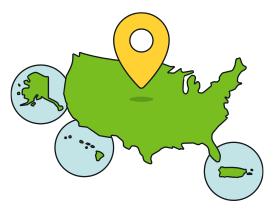
    Humana currently operates more than

    340

    Senior Primary Care centers in 15 states

    Map of the US highlighting over 340 Humana Senior Primary Care centers across 15 states, with emphasis on a pinpoint location
  2. Providing access to skilled home health services

    The need to travel long distances coupled with a lack of transportation options in rural communities is a major barrier to healthcare for elderly residents. In fact, rural residents travel more than twice the distance as urban residents for medical or dental care.3

    Through home healthcare providers CenterWell Home Health and onehome®, Humana provides access to skilled care within the comfort of members’ own homes, helping optimize outcomes for patients who otherwise may have difficulty getting to appointments or finding care providers.

    Patients requiring infusion therapy have access to a home infusion program through onehome, which offers direct delivery and setup for the following services:

    • Antibiotic therapy
    • Chemotherapy
    • Tube feeding or intravenous nutrition
    • Hormonal therapy

    Humana also has a benefit that provides members with access to personal home care services. With this benefit, a professional caregiver or home health aide assists with everything from self-care (i.e., bathing, getting dressed and other personal needs) to moving around (i.e., getting in and out of bed, helping with walkers and more) to meal preparation.

  3. Bringing primary care to seniors’ homes

    Rural residents are especially hard hit by the nationwide shortage of primary care physicians. There are 39.8 physicians per 100,000 residents in rural areas, compared with 53.3 physicians per 100,000 residents in urban centers—and this is expected to get worse.4 The consequence will be that people living in rural communities will need to travel even further to see a primary care provider—this poses an even greater challenge for seniors who struggle with mobility issues and have limited transportation options.

    CenterWell Primary Care Anywhere provides a solution to the problem of doctor shortages in rural communities by enabling members to meet with board-certified providers in the patient’s own home or virtually. CenterWell Primary Care Anywhere also ensures that each patient has a dedicated care team for coordinating specialist referrals, overseeing medication refills, arranging follow-up visits and more.

  4. Providing access to resources through Humana Community Navigator

    Humana Community Navigator® (HCN) helps address health-related social needs for patients who face barriers to accessing services, including seniors living in remote and rural areas.

    HCN is an easy-to-use online tool that connects members with local resources, providing access to more than 500,000 social service programs across the country. HCN supports physicians and care teams in providing whole-person care, no matter where a member resides.

    Programs address common health-related social needs in areas such as food assistance, housing and transportation. There are also programs to help combat loneliness and social isolation.

    Find local programs and resources with Humana Community Navigator.


Sources:
  1. “Rural Health: Addressing Barriers to Care,” NIHCM Foundation, October 25, 2023, accessed July 30, 2025, https://nihcm.org/publications/rural-health-addressing-barriers-to-care?x-craft-preview=500l2VTUmx&token=Mh_dUNRmnLD5mkklxDAy6p0X0Sw8zip-
  2. “CenterWell Poised for Further Primary Care Expansion in 2025,” Humana, Feb. 19, 2025, accessed Aug. 8, 2025, https://news.humana.com/press-room/press-releases/2025/centerwell-poised-for-further-primary-care-expansion-in
  3. “Transportation to Support Rural Healthcare,” Rural Health Information Hub, accessed July 30, 2025, https://news.humana.com/press-room/press-releases/2025/centerwell-poised-for-further-primary-care-expansion-in
  4. “Rural Health: Addressing Barriers to Care,” NIHCM Foundation, October 25, 2023, accessed July 30, 2025, https://nihcm.org/publications/rural-health-addressing-barriers-to-care?x-craft-preview=500l2VTUmx&token=Mh_dUNRmnLD5mkklxDAy6p0X0Sw8zip-.
To learn more, visit Humana Group Medicare
Download PDF